

(Minghui.org) A quiet intensity filled the Lyric Theatre on the evening of April 23, 2026, as community members gathered for a screening of the award-winning documentary State Organs, followed by a panel discussion that brought a human dimension to one of the world’s least understood forms of human trafficking--forced organ harvesting.
Hosted by the Rotary Club of Blacksburg and Montgomery County in partnership with the End Forced Organ Harvesting (EFOH) Rotary Satellite Club, as well as the District Action Group Against Slavery (District 7610), the event combined film, expert analysis, and firsthand testimony to shed light on alleged abuses that have increasingly drawn international concern.
A 2024 report from the U.S. Department of State describes trafficking for the purpose of organ removal as one of the least reported and least understood forms of human trafficking. Organizers said that while such crimes are often associated with vulnerable regions like North Africa and the Middle East, growing evidence points to the systematic targeting of prisoners of conscience in China.
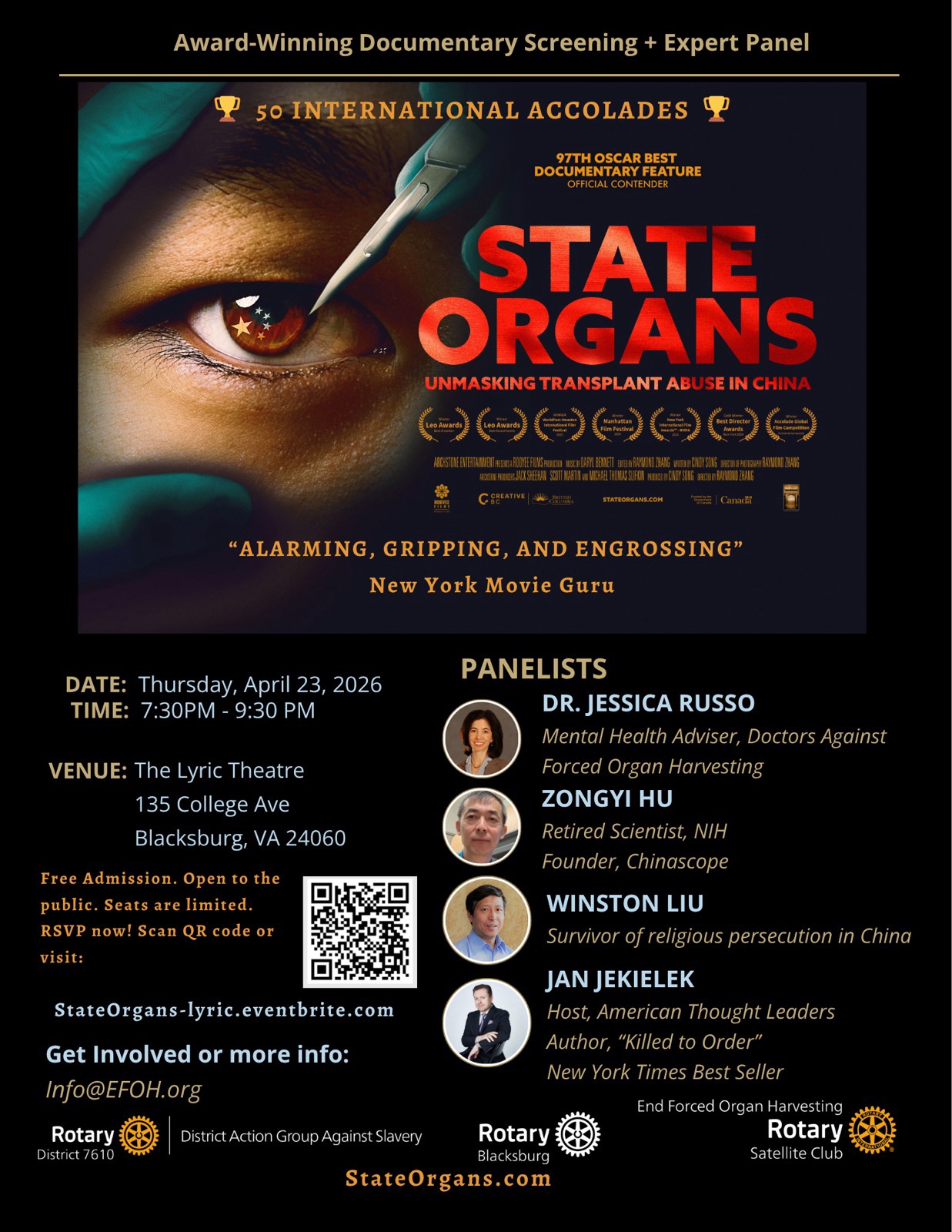 The poster for the screening of State Organs in the Lyric Theatre in Blacksburg, Virginia
The documentary State Organs, an official contender for Best Documentary Feature at the 97th Academy Awards, follows the decades-long search of two families whose loved ones disappeared in China. Their investigation points to what they believe is a state-run system of organ harvesting targeting innocent individuals—many of them practice Falun Gong.
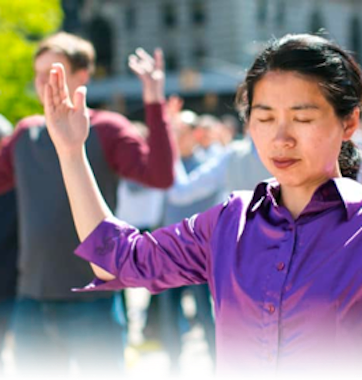
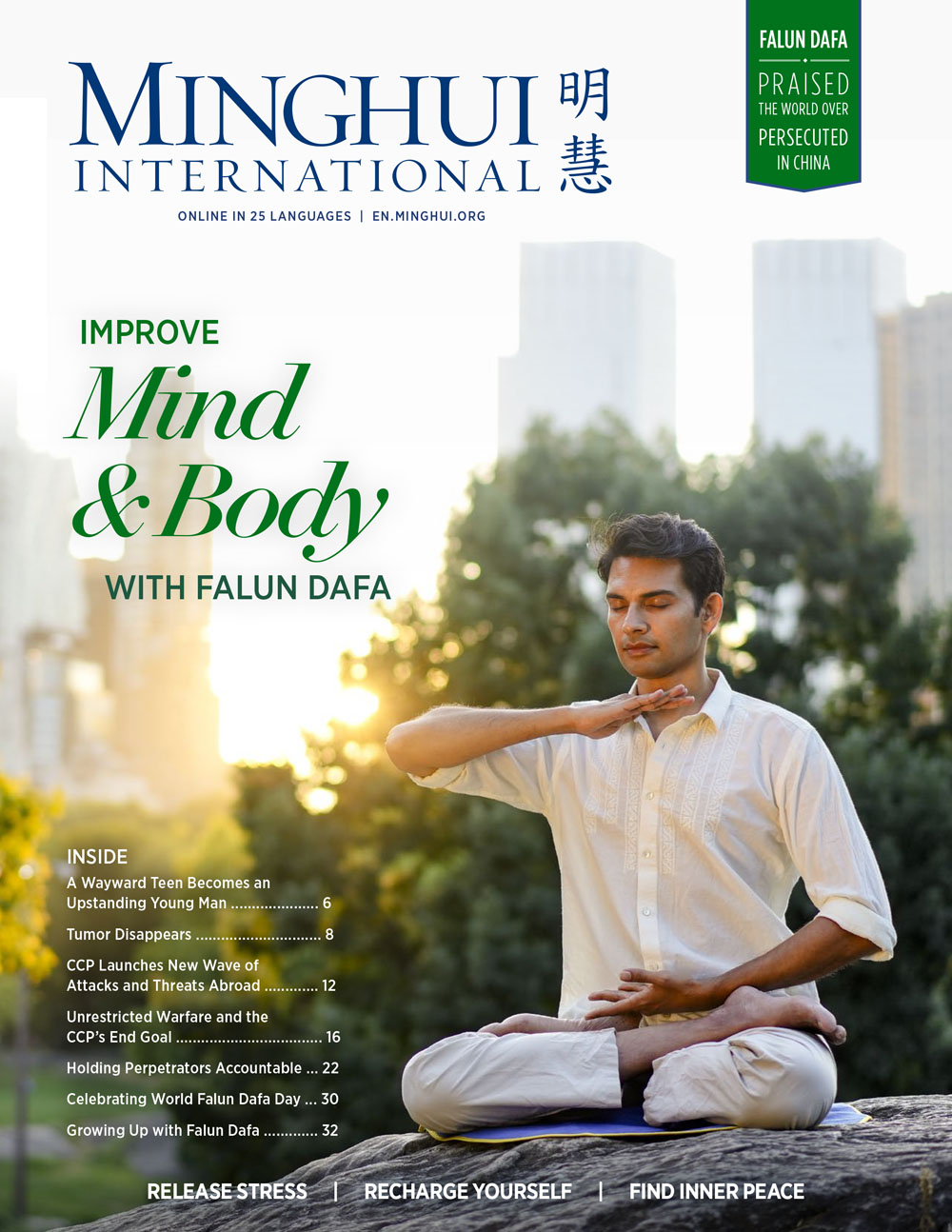
Falun Gong, a spiritual discipline centered on Truthfulness, Compassion, and Forbearance, gained widespread popularity in China during the 1990s, with millions practicing before the Chinese Communist Party (CCP) launched a sweeping persecution campaign in 1999. Since then, survivors and investigators have reported widespread detention, forced labor, and medical testing consistent with organ matching.
Panel Discussion Reinforces the Film's Impact
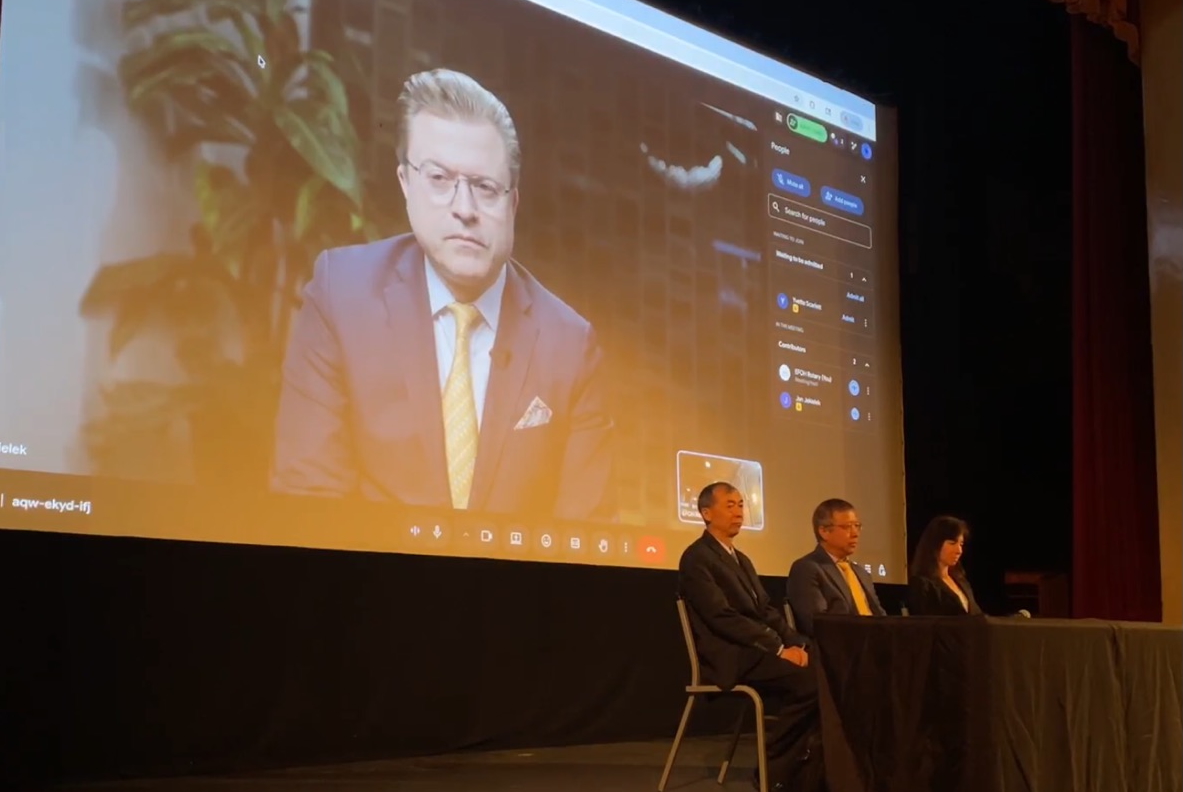 Invited guests answer questions from the audience. On screen is Jan Jekielek, Journalist, host of “American Thought Leaders,” and author of the New York Times bestseller Killing by Order. Front row, from left to right: Mr. Hu Zongyi, retired scientist at the National Institutes of Health (NIH) and founder of Chinascope; Winston Liu, survivor of religious persecution in China; and Dr. Jessica Russo, Mental Health Consultant for Doctors Against Forced Organ Harvesting. (Photo courtesy of the event organizers.)
Winston Liu, a former Ph.D. candidate at Tsinghua University, recounted being imprisoned four times between 1999 and 2003 because he practices Falun Gong. His testimony illustrated the personal cost behind the issue—years of separation, psychological trauma, and the destruction of his family life.
Dr. Jessica Russo, a mental health advisor with Doctors Against Forced Organ Harvesting (DAFOH), addressed the ethical implications for the global medical community, emphasizing the difficulty of verifying consent in opaque transplant systems.
Zongyi Hu, a retired National Institutes of Health scientist, provided insight into why the Western medical community has remained largely silent on China’s transplant system, while journalist Jan Jekielek, author of Killed to Order, highlighted the role of investigative reporting in exposing abuses tied to transplant tourism.
Audience Feedback
Catherine, an attendee, said she was overwhelmed by the scale and brutality depicted in the film, and described it as, “Stunningly awful.”
Another audience member, Kim, called the documentary “shocking, informative, and gut-wrenching,” adding that it would take time to fully process what she saw and learned.
For Rotary member Christy Brown—whose efforts were instrumental in bringing State Organs to the Lyric Theatre—the experience carried a deeper sense of responsibility. She acknowledged that she anticipated the film would be difficult to watch, but felt compelled to act after seeing it.
“I have a responsibility to know,” Brown said, emphasizing the moral obligation that she believes comes with awareness.
Organizers Emphasized That Awareness Alone Is Not Enough
Cindy Liu, chair of EFOH, said the issue is a moral challenge and urged attendees not only to stay informed but to take action.
The U.S. House of Representatives passed H.R. 1540, reflecting growing bipartisan momentum to confront and address these abuses. The Falun Gong and Victims of Forced Organ Harvesting Protection Act (S.4009) is currently under consideration in the Senate. Advocates emphasize that constituent outreach—calls and emails urging senators to support and cosponsor the bill—can play a critical role in moving it toward passage.
Copyright © 1999-2026 Minghui.org. All rights reserved.